English
 Deutsch
 Espanol
 Français
 Portuguese
 中文
中文 한국어
한국어 日本語
日本語
Apache ActiveMQ
What is Apache ActiveMQ and How Does It Work?
Apache ActiveMQ is a popular open source, multi-protocol, Java-based message broker. It supports industry standard protocols allowing users to connect from clients written in JavaScript, C, C++, Python, .NET, and other languages. Apache ActiveMQ is written in Java together with a full Java Message Service (JMS) client.
If you are unfamiliar with message queues and brokers, you may like to start by reading this overview, see: What is a Message Queue? - IT Glossary | eG Innovations.
As an open-source project, ActiveMQ is maintained and governed by the Apache Software Foundation (ASF). The Apache ActiveMQ community consists of developers and contributors from various organizations and individuals who collaborate on the development, enhancement, and support of the ActiveMQ messaging broker.
There are currently two varieties of ActiveMQ available - the established "classic" broker and a "next generation" broker named “Artemis”. Apache stated that when Artemis reaches enough feature parity with the "Classic" codebase, it will become the next major version of ActiveMQ. Initial migration documentation is available as well as a development roadmap for Artemis.
Apache ActiveMQ Classic is a message broker which supports multiple wire level protocols for maximum interoperability, including:
Apache Artemis offers some features beyond the “classic” broker such as, high availability using shared storage or network replication (rather than just shared storage as per classic), asynchronous mirroring for disaster recovery and a few other features around clustering and persistence designed with modern distributed architectures in mind.
Apache Kafka vs. Apache ActiveMQ: What Is the Difference?
Apache Kafka and ActiveMQ are messaging systems, but with distinct architectures and use cases. Kafka is a distributed streaming platform built for high-throughput, fault-tolerant storage, and processing of streaming data. It follows a publish-subscribe model and is ideal for real-time stream processing, log aggregation, and data integration. Kafka is fundamentally a distributed event streaming platform designed to ingest and process massive amounts of data.
ActiveMQ, however, is a traditional message broker implementing the JMS API. It supports various messaging patterns including point-to-point and publish-subscribe, focusing on reliability and compliance with messaging standards. ActiveMQ is commonly used in enterprise scenarios requiring guaranteed delivery and transaction support, such as order processing and application integration. While Kafka excels in scalability and real-time processing, ActiveMQ prioritizes reliability and standards compliance for traditional messaging needs. The choice between the two depends on the specific requirements of the application.
Why is ActiveMQ Monitoring Important?
ActiveMQ monitoring helps IT teams track broker availability, message throughput, queue and topic backlogs, connections, resource utilization, and consumer performance. Monitoring these metrics helps identify bottlenecks and potential issues before they affect applications that depend on messaging services.
What ActiveMQ Metrics Should You Monitor?
Key metrics and statistics related to the performance of a ActiveMQ Server should allow administrators to find accurate answers for the following performance queries:
Beyond ActiveMQ metrics, logs, traces and events you will also want to monitor the supporting stack and the infrastructure / cloud you run it upon.
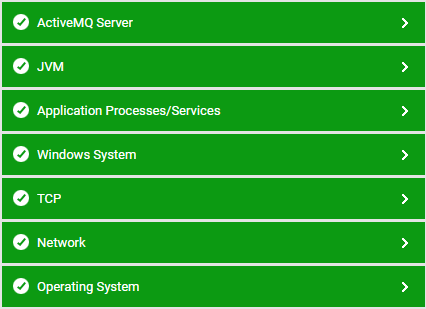
eG Enterprise layer model covers ActiveMQ and all its underlying dependencies such as JVM, Networking, OS and more.
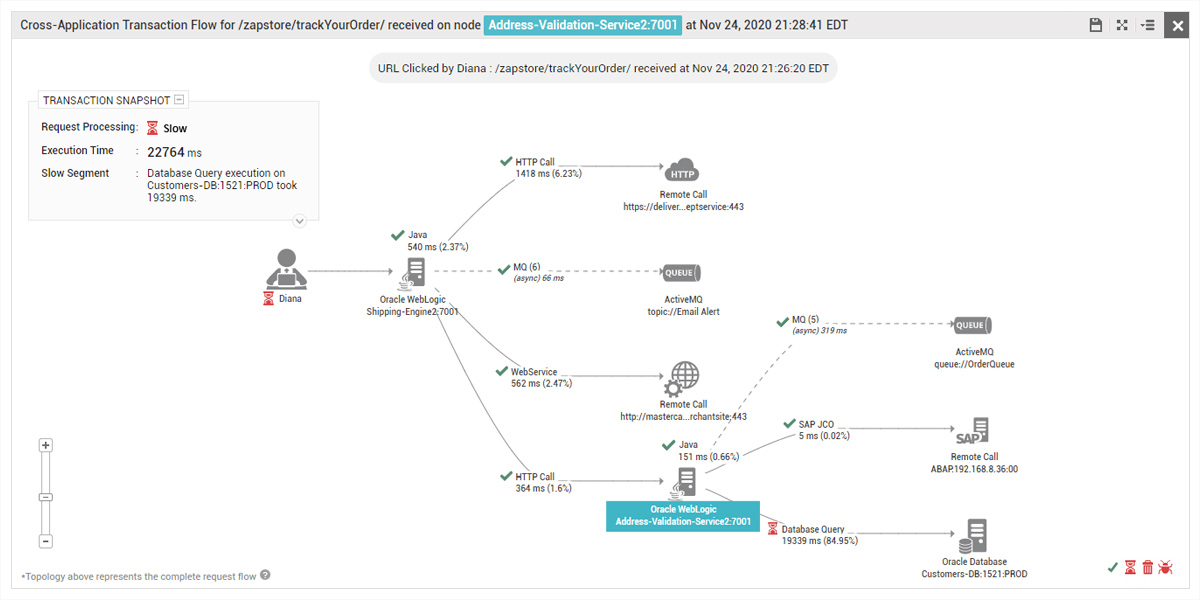
Application transaction tracing and topology views within eG Enterprise provide deep insights and automated root-cause diagnostics to eliminate bottlenecks caused by ActiveMQ within complex architectures.
What are the Best Tools for ActiveMQ Monitoring and Management?
There are several tools available for monitoring and managing ActiveMQ instances, providing administrators with insights into the health, performance, and activity of their messaging infrastructure. Some popular tools include:
These options often give rather limited visibility, covering only some of the dependencies of an application built using ActiveMQ. As a result, most enterprise users rely on third-party out-of-the-box solutions such as Datadog, New Relic, Dynatrace and eG Enterprise which offer key features such as Distributed Transaction Tracing. The licensing costs of these options varies considerably and for many use cases eG Enterprise is the lowest cost option, see: How eG Enterprise IT Monitoring Licensing is Cost-Effective and Flexible | eG Innovations.
Frequently Asked Questions (FAQs)
Apache ActiveMQ is an open-source message broker used to enable reliable communication between distributed applications and services. It supports message queuing, publish-subscribe messaging, and enterprise integration, helping systems exchange data asynchronously while improving scalability, availability, and fault tolerance.
ActiveMQ is a traditional message broker designed for reliable message delivery and enterprise messaging, while Apache Kafka is a distributed event streaming platform built for handling high-volume, real-time data streams. ActiveMQ focuses on messaging and queue management, whereas Kafka excels at large-scale event processing and data streaming.
Key ActiveMQ metrics include queue size, message throughput, consumer and producer rates, pending messages, broker uptime, memory usage, CPU utilization, disk storage, network performance, and failed message counts. Monitoring these metrics helps ensure optimal broker performance and message delivery reliability.
ActiveMQ monitoring is important because it helps identify performance bottlenecks, message delivery issues, resource constraints, and system failures before they affect applications. Effective monitoring improves reliability, minimizes downtime, maintains service levels, and ensures smooth communication between connected systems.
ActiveMQ can be monitored using eG Enterprise, which provides comprehensive visibility into broker health, queue and topic performance, resource utilization, messaging activity, and end-user impact. IT teams can leverage intelligent dashboards, historical analytics, automated alerting, and root-cause diagnostics to proactively identify performance bottlenecks, optimize messaging infrastructure, and ensure reliable message delivery across the environment.
Yes, ActiveMQ supports monitoring through Java Management Extensions (JMX). JMX provides access to broker statistics, queue and topic metrics, connection details, memory usage, and other performance indicators, enabling administrators to monitor and manage ActiveMQ in real time.
Yes, Apache ActiveMQ is primarily written in Java. It is a Java-based messaging platform that supports multiple messaging protocols and integrates easily with Java applications as well as applications developed in other programming languages.
ActiveMQ Artemis is the next-generation messaging broker from the Apache ActiveMQ project. It is designed for high performance, scalability, and low latency, offering advanced messaging capabilities, improved resource efficiency, and support for modern enterprise messaging workloads.